Xingqiao Subscriptions vs. WildCard: Comparing Safe Ways to Upgrade ChatGPT Plus in China
By Ernest · ·
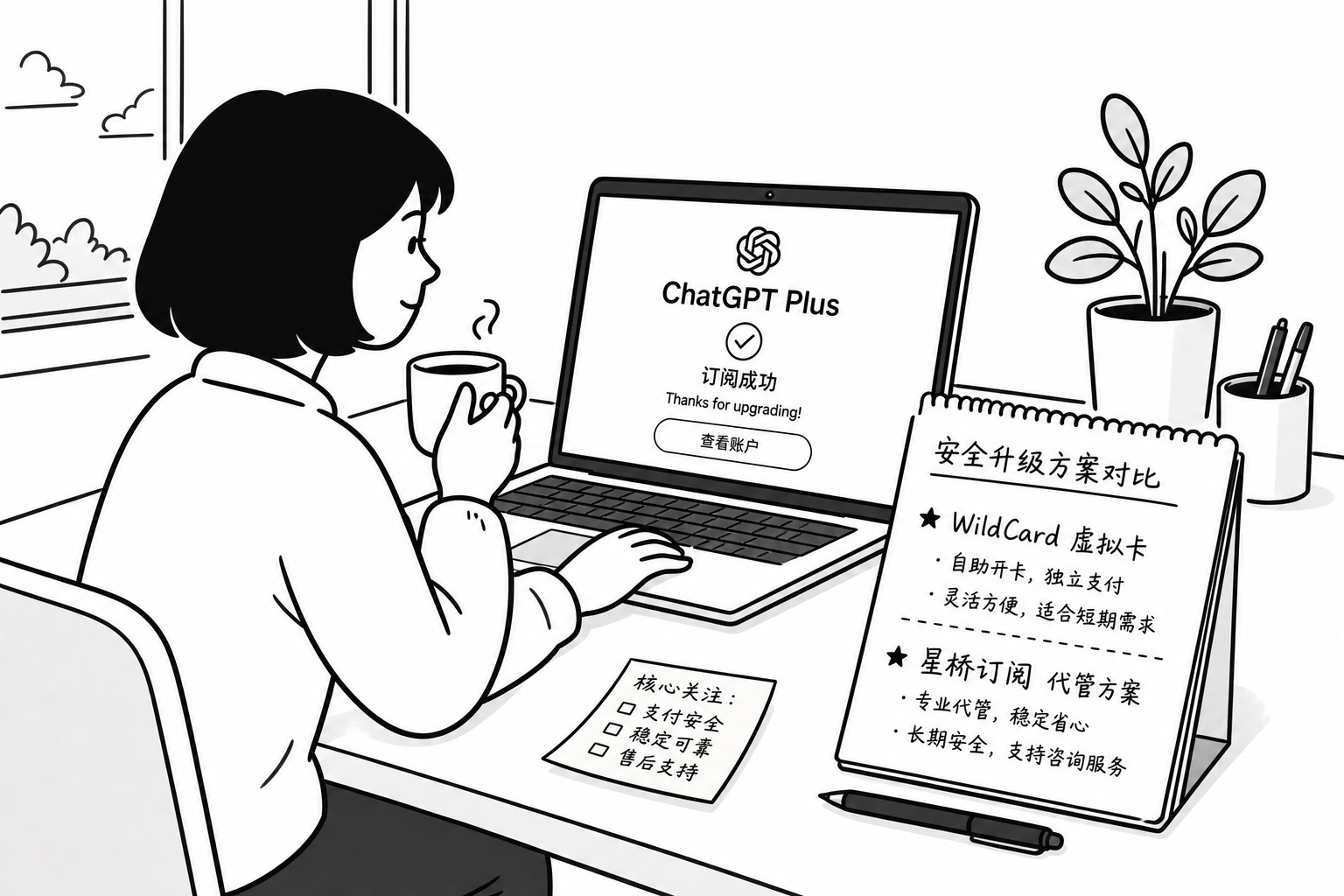
For developers, content creators, and students in mainland China, upgrading to ChatGPT Plus often turns into a standoff with OpenAI's payment risk controls. Just as you're getting ready to try GPT-4o's stronger reasoning, Advanced Data Analysis, or custom GPTs, the message you're most likely to see is one cold line: "Your card has been declined."
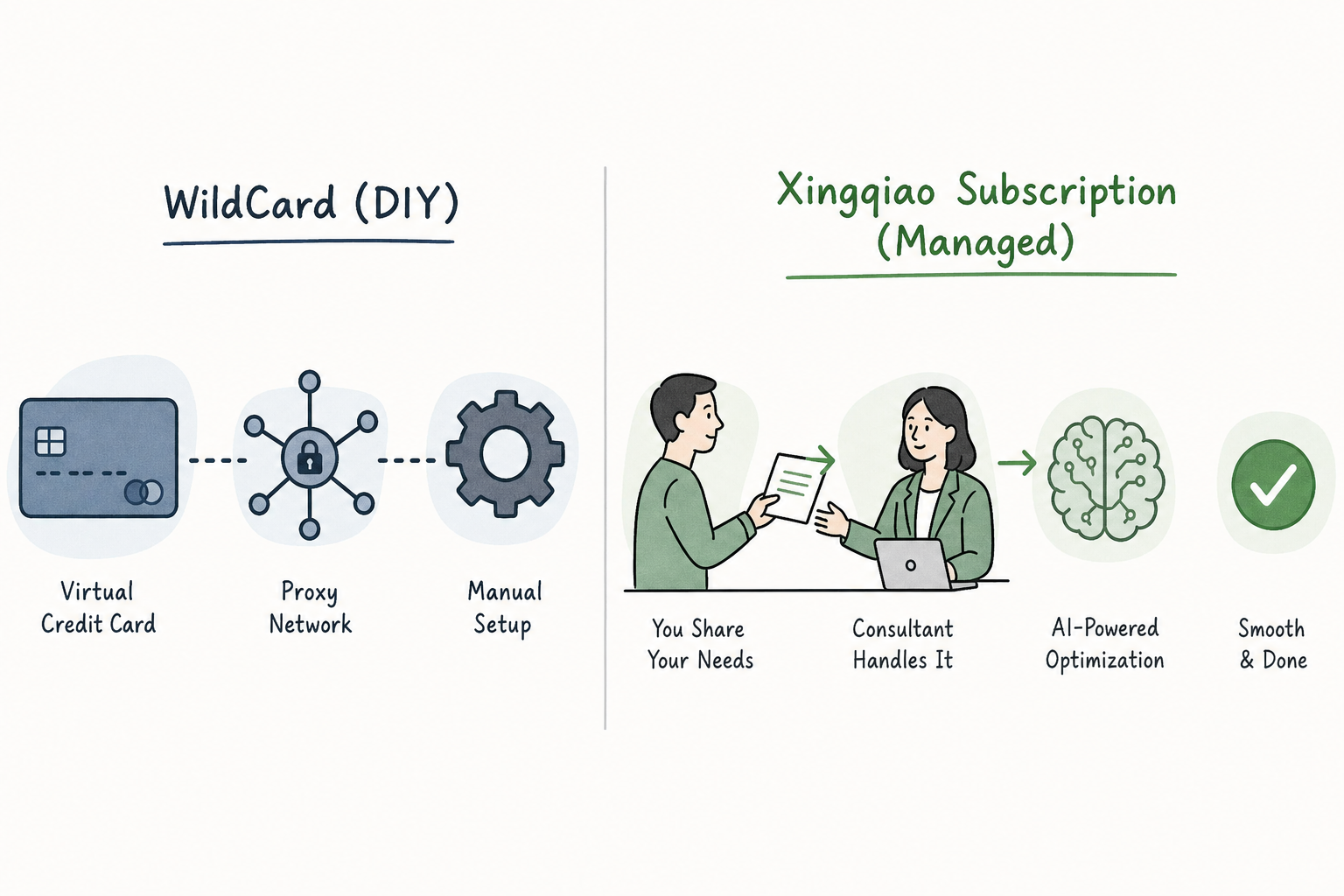
Facing that payment wall, the market has evolved two very different paths: WildCard, the leading "virtual-card, do-it-yourself" option, built on self-service; and Xingqiao Subscriptions, representing the "fully managed, plus expert consulting" approach — one that not only solves the payment problem, but focuses on turning AI from a "chat tool" into an "automated agent."
This article breaks down both mainstream paths in depth — from the underlying payment mechanics and risk-control safety, to hidden costs and the productivity gains that follow — to give you the most complete decision guide available.
Why is upgrading ChatGPT Plus from China so hard?
Before getting into solutions, it helps to understand the root cause: why can't an ordinary Chinese multi-currency credit card (Visa/Mastercard) pay for ChatGPT Plus directly?
1. Stripe's strict risk controls
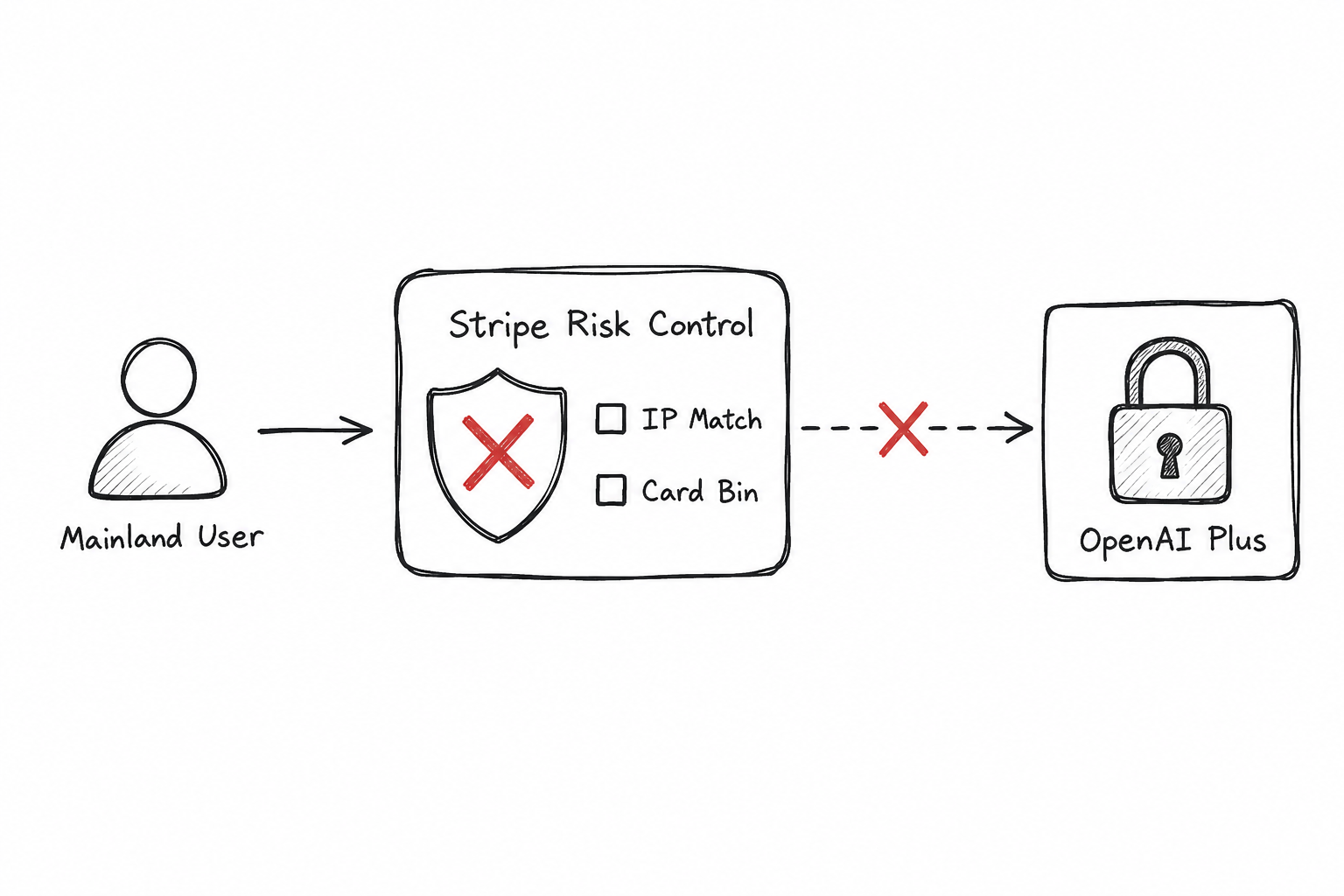
OpenAI uses Stripe, a globally recognized payment processor. Stripe applies very high fraud-detection standards to payments from high-risk or unsupported regions (including mainland China). The instant you hit submit on the payment page, Stripe cross-checks the following in milliseconds:
- IP location: whether your current proxy IP belongs to a data-center range, and whether it's been abused by many different users.
- Issuing bank's country: the country tied to your card's BIN (its first six digits).
- Billing address: whether the address you entered matches the country of your IP and issuing bank.
If these three signals seriously conflict — say, you're using a Japanese proxy IP, entered a billing address in a US tax-free state, but the card is a Visa issued by a Chinese bank — Stripe's risk engine will instantly flag the transaction as high risk and decline it 2.
2. Shared accounts and stolen cards bring guilt-by-association ban risk
Because direct payment is so difficult, e-commerce platforms have long been flooded with cheap "top-up" or "shared account" listings priced at just a few dollars. These bargain services often hide serious risk:
- Stolen/carded payments: some unscrupulous sellers use stolen overseas credit cards to pay for your top-up. When the real cardholder files a chargeback, OpenAI bans the account immediately — and every chat log and prompt you've built up disappears in an instant.
- IP contamination and guilt-by-association bans: buying a cheap shared account means sharing it with a dozen-plus other people. Everyone logging into the same account at different times from cheap proxy nodes scattered around the world looks like "teleporting" to OpenAI's anomaly detection — and the account gets banned almost instantly 1. As one veteran user put it on the Jike app: "Carpool with a rookie for two days and you'll burn through an account — so satisfying" 3.
Since borrowing a relative's overseas card or buying a cheap black-market account isn't a reliable option either, the real choice comes down to a virtual credit card (WildCard) versus a managed subscription service (Xingqiao Subscriptions).
Option 1: WildCard virtual-card self-service upgrade (the DIY pick)
A virtual credit card (VCC) is currently the most common self-service upgrade method in China's tech community. WildCard is the leading platform in this space — built specifically for users in China, supporting Alipay identity verification and top-ups, which lowers the barrier significantly.
How WildCard actually works
WildCard essentially issues you a sub-card under a real overseas bank-account structure (typically a US-issued Visa or Mastercard). You top up RMB via Alipay, WildCard converts it to USD at the live exchange rate and loads it onto your virtual card, and you then use that card's details to pay on OpenAI's official site.
Step-by-step process
- Sign up and verify your identity: register on WildCard's official site with a Chinese phone number, then complete Alipay-based facial-recognition identity verification (required for KYC compliance).
- Open the card and top up: pay the card-issuing fee (typically $9–$15, depending on the card's validity period). Once issued, top up at least $20 via Alipay (the monthly ChatGPT Plus fee).
- The "one-click upgrade" that bypasses network risk controls: because many users' self-configured proxy IPs aren't clean, filling in the card directly on the web page can still get declined by Stripe. WildCard's workaround: on ChatGPT's official site, click "Upgrade to Plus" to reach the Stripe payment page, don't fill in the card — instead, copy the long URL in your address bar that starts with
pay.openai.com. Paste that URL into WildCard's "one-click upgrade" field in its backend, and the system submits the form and completes the charge from a clean overseas server environment on your behalf 4.
Advantages
- Full control: the account and payment method stay entirely in your own hands — this is a genuine official subscription, with no third party ever handling your account or a verification code.
- Reusable across services: the same virtual card can also pay for Midjourney, Claude Pro, Poe, GitHub Copilot, and US Apple ID purchases.
- Transparent pricing: aside from the card-issuing fee and a small service charge, the monthly subscription is the official $20 — no markup from a middleman.
Drawbacks and hidden costs
- Higher sunk cost and idle funds: the card-issuing fee is a fixed cost, and virtual-card platforms typically enforce a minimum top-up. If you only plan to try it for a month, this isn't the most economical option.
- Ongoing network-environment challenges: while the "one-click upgrade" solves the IP problem at the moment of payment, frequently switching to cheap proxy nodes in day-to-day use can still get the account flagged as high-risk by OpenAI.
- A real learning curve: for non-technical creators or liberal-arts students, understanding virtual cards, KYC verification, funding in USD, and troubleshooting the occasional failed charge (e.g., insufficient balance) is a meaningful barrier to entry.
Option 2: Xingqiao Subscriptions' managed service + 1-on-1 agentic AI consulting (the low-effort, high-productivity pick)
If dealing with virtual cards and IP risk controls feels like too much hassle — or if what you really want isn't just a Plus account but guidance on weaving AI into your actual workflow — then a fully managed, one-stop service like Xingqiao Subscriptions is the better answer.
Many tutorials recommend "AI subscription/co-op services built for users in China that don't require a credit card at all" 5. Xingqiao Subscriptions is the upgraded version of that model — not just a top-up middleman, but a service provider focused on making AI productivity actually happen.
Xingqiao Subscriptions' core service model
Xingqiao Subscriptions removes the overseas-payment barrier for users in mainland China, activating Plus directly on your own independent OpenAI account through a compliant enterprise-grade payment channel or compliant proxy-payment network. You don't need to complete overseas financial KYC or handle currency conversion — just pay the way you normally do in China, and the subscription is done.
For ChatGPT Plus, the order flow looks like this:
- In the pricing section, choose ChatGPT Plus (¥165/month) and pay by card / Apple Pay (Stripe checkout) or WeChat Pay.
- After payment, on the "Subscription details" page: sign in to the account you want to upgrade, open
https://chatgpt.com/api/auth/session, copy everything on the page (your Session), confirm the sign-in email the page shows, and submit. No account password or verification code is needed. - After payment is verified, the top-up is expected to take 3–5 minutes; sign in to ChatGPT to check it's active.
Why is it more than just a "proxy subscription"?
The biggest difference between Xingqiao Subscriptions and an ordinary top-up platform (or even a shared-account platform) is its dual-track service structure: a seamless subscription channel underneath, and 1-on-1 agentic AI consulting on top.
- A clean, dedicated account — no guilt by association: Xingqiao Subscriptions firmly rejects "one account, sold many times." What we upgrade is your own independent email account. Xingqiao Subscriptions doesn't use stolen or unknown-origin cards, reducing chargeback-driven ban risk at the source.
- Moving past tools, into workflow: many users, after spending $20 on an upgrade, still treat GPT-4 as little more than an advanced search engine. Xingqiao Subscriptions' consultants tailor 1-on-1 guidance to your profession — developer, content creator, or student. For example:
- For developers: guidance on combining ChatGPT Plus with local terminal tools (like Claude Code or Codex) to build an automated code-review and generation pipeline.
- For content creators: how to use Advanced Data Analysis to batch-process data, or build a dedicated Custom GPT that scrapes, summarizes, and generates multilingual copy automatically.
- Seamless switching between models: as AI keeps evolving quickly, the strongest model can shift between OpenAI, Anthropic (Claude), and Google (Gemini) at any time. Xingqiao Subscriptions supports not just ChatGPT Plus but also Claude Pro and other premium subscriptions. When you're not sure which to renew, our consultants give recommendations based on your recent needs — whether that's long-context coding or complex reasoning.
Advantages
- The simplest possible onboarding: no virtual-card registration, no fiddling with payment links — hand the technical black box entirely to Xingqiao Subscriptions.
- No network payment risk: no need to worry about your own proxy IP getting blacklisted by Stripe.
- Real added value: the agentic AI consulting (billed separately at ¥699/hour) helps you quickly move past the "I don't know what to do with this" phase, turning a $20/month tool into a digital employee that can save dozens of hours a month.
Drawbacks and who it's not for
- Not for the "I want full control" crowd: if you strongly prefer managing everything yourself and frequently need to bind cards to various obscure overseas platforms, owning a WildCard is clearly more versatile.
- A service premium: compared to a fully self-service channel, Xingqiao Subscriptions' pricing includes the cost of managed handling, and 1-on-1 consulting is billed separately. The total cost differs from carefully maintaining your own virtual card — but you get time saved and guidance in return.
Xingqiao Subscriptions vs. WildCard: head-to-head comparison
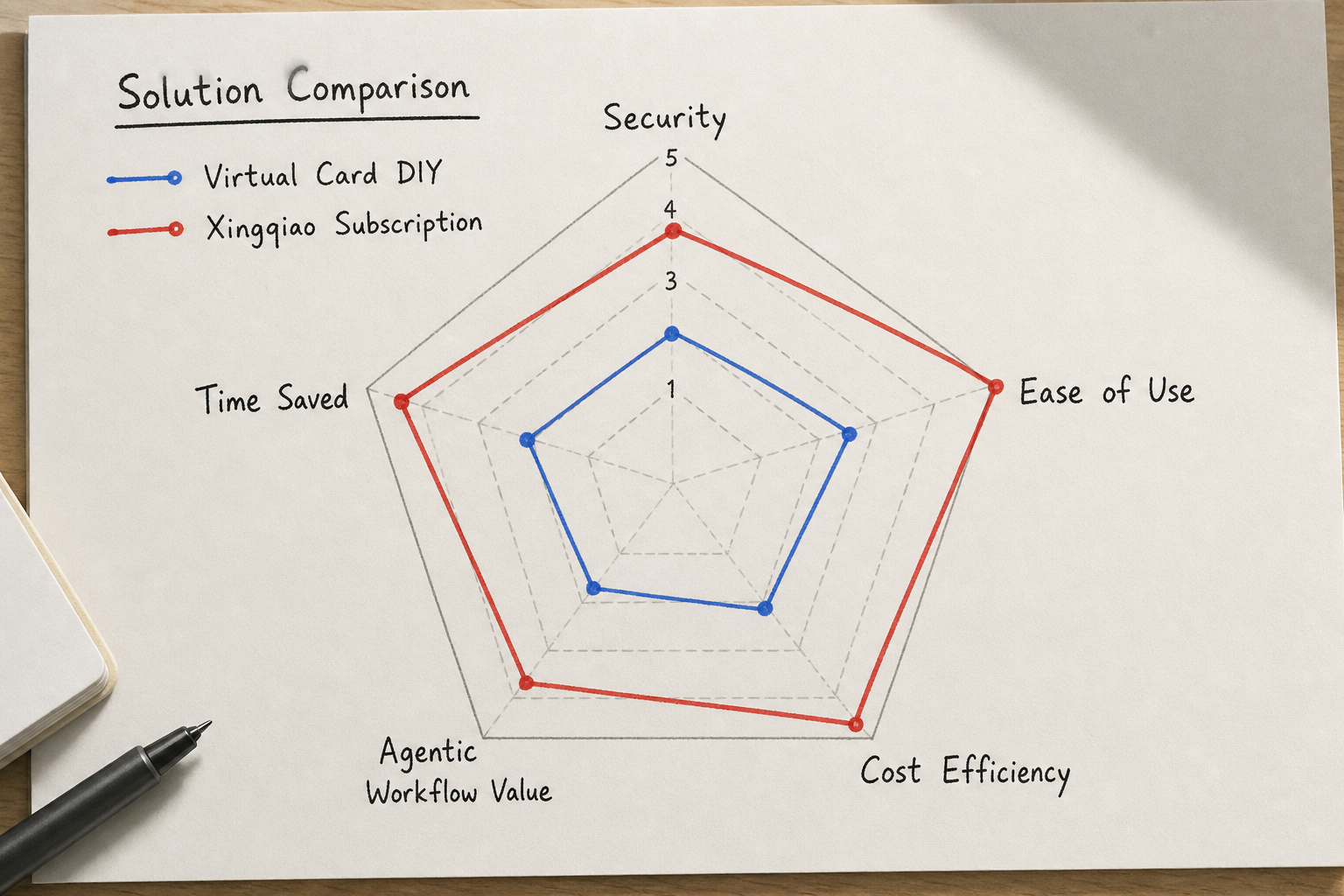
To make the differences easier to see at a glance, here's a decision matrix:
| Dimension | WildCard (self-service virtual card) | Xingqiao Subscriptions (managed + consulting) |
|---|---|---|
| Safety & risk control | Fairly high (requires a clean IP; some chance of triggering a Stripe warning) | Very high (payment handled by a dedicated overseas node, isolating you from network risk) |
| Setup complexity | Complex (identity verification, USD top-up, copying payment links to bypass risk controls) | Very low (pay the way you normally do in China; for Plus, submit a Session and confirm the email after payment — no password, about 3–5 minutes) |
| Upfront/hidden costs | Card-issuing fee ($9–$15), FX loss, minimum-balance lock-up | No card fee, no idle funds; pay per subscription cycle and service package |
| Where it applies | Broad (can pay for many overseas apps, US Apple ID, etc.) | Focused (specialized in top AI subscriptions like ChatGPT/Claude) |
| Core added value | Payment channel only — figuring out how to use AI is on you | Core strength: 1-on-1 agentic AI consulting to help you actually apply it |
| Best for | Tech-savvy users comfortable with overseas services, needing multi-platform payment, willing to invest time | Developers, creators, and researchers who'd rather spend their time on their actual work |
Avoid these: 3 upgrade methods to steer clear of
Before picking the right path, it's just as important to recognize the dead ends. Whether you go the self-service or managed route, steer clear of these three traps:
- "Pre-made" or "shared" accounts for a few dollars Taobao and Xianyu are full of Plus accounts priced at ¥30–50 — a price that makes no logical sense (the official cost is $20, roughly ¥145). These accounts are either "burner" accounts charged with stolen cards (banned within days) or shared among a dozen-plus people. Beyond losing access without warning, your confidential work and private code get exposed to strangers sharing the same account.
- A middleman on Taobao asking for your OpenAI password Some low-quality sellers ask for your account password and log in themselves to bind a card. Because the seller's network environment is often compromised (they may have just topped up a now-banned account minutes earlier), this kind of service is extremely likely to trigger OpenAI's guilt-by-association ban mechanism. Xingqiao Subscriptions never asks for your password: for Plus, you submit only your current Session after payment and confirm your sign-in email. The Session is used only for this one subscription top-up and is not written to the database or logged.
- Borrowing a stranger's overseas card or a temporary SMS number Don't try to find someone online willing to pay on your behalf. If their card gets flagged, or the login happens from an unfamiliar location, your account gets permanently marked. As one veteran on Jike warned: "Nobody's actually going to lend you that stuff — if someone does, it's either sketchy or a high-risk card" 3.
Going further: turning Plus into an agentic workflow after you upgrade
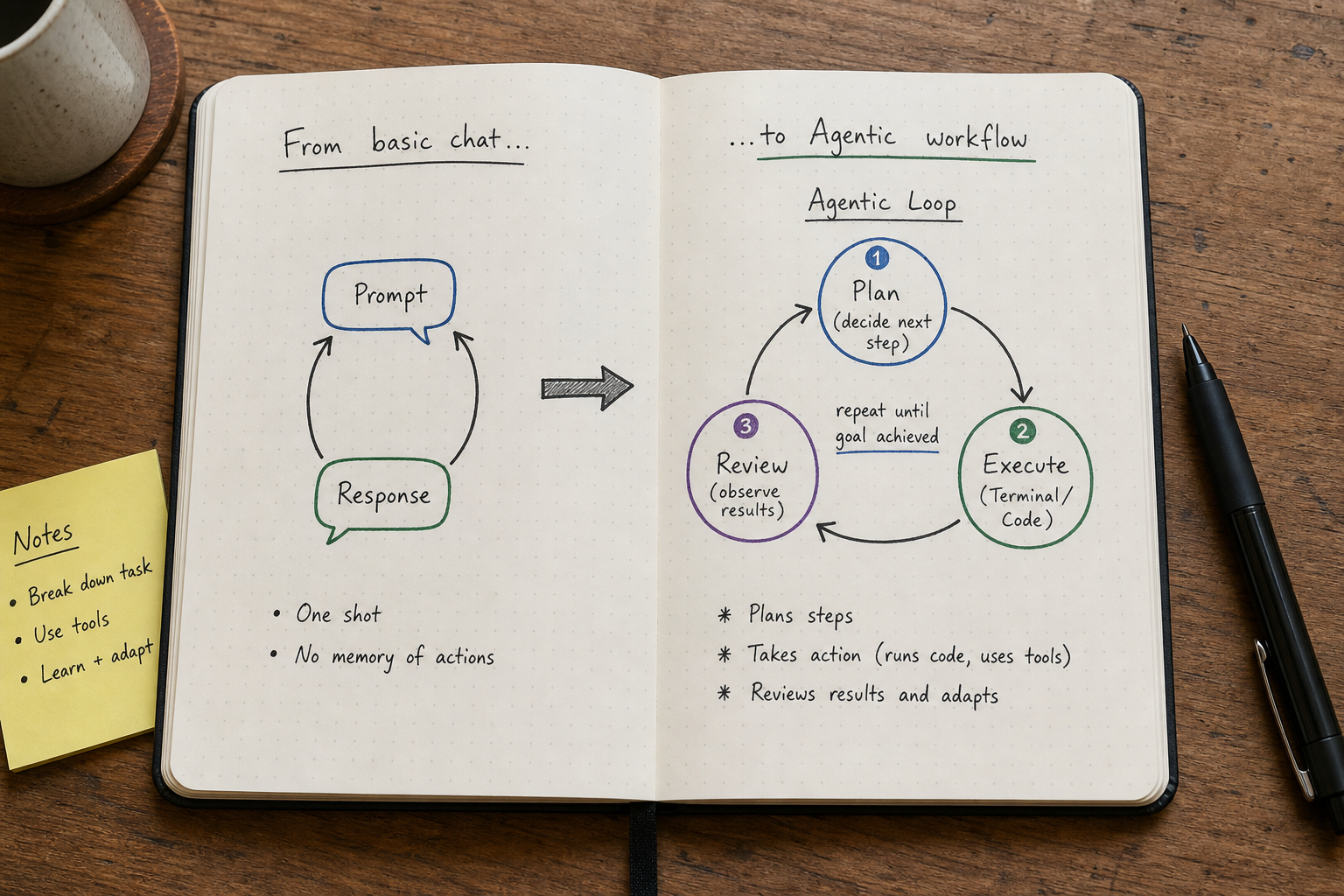
Paying for the upgrade is only step one — how do you make sure every month's subscription is actually worth it? This is a point Xingqiao Subscriptions keeps coming back to in its 1-on-1 consulting: stop treating AI as a smart encyclopedia, and start treating it as an agent that can execute tasks.
If you've already upgraded through either method above, try these next-level moves right away:
1. Deeply integrate Custom GPTs with external APIs
Stop repeating your requirements in every conversation. Use the Plus-exclusive GPTs feature to build your own personal assistant. In the configuration page, upload your brand style guide, coding standards, or even connect external APIs (like Zapier or the Notion API) through Actions.
Example: Xingqiao Subscriptions once helped a content creator connect their custom GPT to a data-analysis API for Xiaohongshu. The creator just drops in a topic, and the GPT automatically pulls recent high-performing headline structures and outputs a finished draft with the right emoji and formatting — cutting formatting time by 70%.
2. Use Advanced Data Analysis for complex tasks
Many people don't realize ChatGPT Plus includes a full Python runtime. You can upload a multi-megabyte Excel file, a long PDF, or a messy log file directly, and have it clean, visualize, or even build a machine-learning model from the data — a level of data analysis the free tier simply can't match.
3. Move toward agentic architecture with Claude Code and Codex
If you're a developer, copy-pasting code through the ChatGPT web app alone is already outdated. In Xingqiao Subscriptions' advanced consulting, we typically point developers toward deeper agent tooling.
For example: using an API key to configure a Claude Code-style command-line agent in your terminal — one that reads your local project directory directly, understands the context, finds bugs on its own, and, with your confirmation, edits files and commits to Git. That "sense, think, act" loop is the real endgame of AI-powered productivity.
FAQ
Q: If I was on a free account, will my old chat history still be there after upgrading?
Yes. Whether you self-serve through WildCard or upgrade through Xingqiao Subscriptions' managed service, as long as it's your own existing account being upgraded, your entire chat history stays exactly as it was, and you'll see GPT-4, GPT-4o, and the related advanced-feature dropdown unlocked at the top of the interface.
Q: Can I cancel anytime if I don't want to continue next month?
Yes. With WildCard, log into OpenAI's official site, go to My Plan, and click Cancel Subscription — you won't be charged next month. With Xingqiao Subscriptions, simply don't place a new order when it expires; there's no hidden lock-in clause.
Q: Should I get ChatGPT Plus or Claude Pro?
It depends on what you need most. If you rely on voice conversations (GPT-4o is very strong there), need deep ecosystem integration (GPTs), and heavy Python-based data analysis, go with ChatGPT Plus. If you're a heavy writer, or need to drop in tens of thousands of lines of code for review in one go, Claude 3.5 Sonnet currently has a slight edge in long-context handling and coding. If you're torn, Xingqiao Subscriptions' 1-on-1 consulting exists exactly to help you make that call.
Conclusion: pick the option that matches the value of your time
In 2026, as OpenAI keeps tightening its risk controls, the "free and effortless" shortcut to safely upgrading ChatGPT Plus from China no longer exists.
If you love digging into the technical details, enjoy having full control over every step of the underlying payment chain, and your network environment is clean and stable, WildCard is clearly the pick for the DIY-minded.
But if you're an efficiency-focused developer, a creator publishing daily, or a student buried in coursework — someone who'd rather not burn valuable time figuring out how to get past Stripe's "Declined" message, and who'd rather have someone walk them through writing flawless project code or business copy with AI — then Xingqiao Subscriptions' one-stop managed service plus 1-on-1 agentic AI consulting is the shortest path to your future workflow.
Don't let a payment wall keep you from the most advanced productivity tools available. Pick the option that fits you, and start your AI journey today.